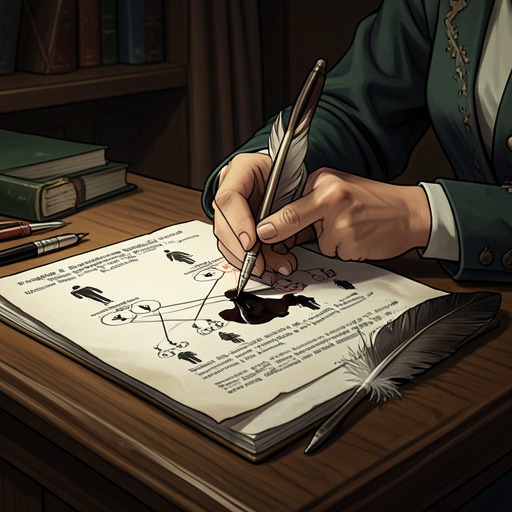
Lula Landry leaves a will
The Cuckoo's CallingLula Landry’s will was a handwritten document made on the day she died, witnessed by Rochelle Onifade, and concealed inside a handbag in the home of her adoptive mother, Yvette Bristow. It named Lieutenant Jonah Agyeman, rather than John Bristow, as the beneficiary of her entire estate. Its discovery transformed a seemingly incidental remark about inheritance into a central clue: Lula had been making a legal provision for her half-brother, and her will did not mean what John and others assumed it meant.
The intention behind the will
Earlier on the day of her death, Lula told Ciara Porter that she intended to leave “everything” to her brother. Porter remembered that Lula seemed low and anxious and would not explain what was troubling her. The remark gave her words a morbid cast, but did not identify which brother she meant or explain why she was making a will.
John Bristow later insisted to Cormoran Strike that Lula would never have left everything solely to him. He said doing so would have explicitly excluded their mother, which would have sent a deeply hurtful message; the issue, he stressed, was not money, since their father had left their mother well provided for. His confidence appeared to support his view of the family’s relationships, but it also made the will’s actual beneficiary crucial. The document did not name John at all.
Lula’s earlier conversation with Porter aligned with the evidence Strike subsequently assembled. He connected the remark about leaving everything to her brother with a pale-blue piece of paper that Lula had possessed before visiting Vashti. Strike reasoned that she had written a will in the car, taken it to the boutique to have Rochelle witness it, and then left the paper hidden rather than abandoning the intention. This was his reconstruction of the will’s making, not a witnessed account of the writing itself; the document’s discovery and signature of a witness gave the hypothesis material confirmation.
Concealment and discovery
The will was not in an obvious file or drawer. While searching Yvette Bristow’s bedroom, Strike examined new handbags stored high in a wardrobe. One white bag had an African-print lining that could be unzipped and removed. Beneath the rigid board supporting its base, he found a folded piece of pale-blue paper covered in untidy handwriting. The hidden position accounted for why the document had not surfaced during the earlier investigation.
Strike placed the paper in a clear plastic bag without reading it in the wardrobe. He then went into the en-suite bathroom, closed the door, and read it there while flushing the toilet and running the taps, giving the nurse in the bedroom an explanation for the sounds. The document was written on Yvette’s writing paper and witnessed by Rochelle Onifade. Its location connected an apparently ordinary handbag in Yvette’s room to a private legal decision Lula had made shortly before her death.
The discovery also gave significance to an overlooked trace from the night of the death. When Strike had Derrick Wilson retrace his search of Lula’s flat, Wilson remembered slipping backward on the stairs where there had been drops of water. Strike later explained that John had carried white roses from the neighbouring flat, leaving small drops behind after wiping their ends. The clue belonged to the reconstruction of the murder, not to the will itself, but the two lines of evidence converged: Lula’s concealed paper and the physical details of the scene both undermined the initial account of her death.
The named beneficiary
When Strike revealed the will’s contents to John, he told him that Lula had left her entire estate to her brother, Lieutenant Jonah Agyeman of the Royal Engineers. John’s response—asking who Jonah was—exposed the gap between his confident assumption and Lula’s actual choice. The named beneficiary was not John, the adoptive brother to whom Lula had reportedly referred, but Jonah, her half-brother.
That distinction mattered beyond the distribution of money. Lula’s family ties included both her adoptive relationship with John and her connection to Jonah; the will made the latter consequential in a concrete, legal form. John’s earlier argument had treated the question as whether Lula could have meant to exclude their mother by leaving everything to him. The document revealed a different arrangement altogether: Lula had selected another brother, so the apparent choice between John and their mother had been a false frame.
The estate was substantial enough to carry weight in the investigation. Guy Somé described a five-million-pound contract Lula had been expected to front for his accessories line, and complained that negotiations had become focused on money. That contract was not the same thing as the will or proof of its motive, but it gives context to the scale of the estate that Strike later described as Lula’s entire property. The will made inheritance relevant to the people around her while also demonstrating that her intentions could not be inferred from their assumptions about her.
Significance to the investigation
Strike interpreted the will as evidence that Lula had not written a suicide note hours before her death and then gone dancing. In his reconstruction, she was taking practical steps to make her wishes legally effective: she wrote the document, sought Rochelle’s witness, and concealed it in a bag. He linked those actions with Lula’s anxious mood, her remark to Porter, and her effort to bring Rochelle across town. The evidence did not by itself explain every circumstance of Lula’s final night, but it supplied a coherent purpose for the blue paper and a reason it had mattered to her.
The document also sharpened the contrast between direct evidence and the stories people told about Lula. Porter’s memory supplied an earlier statement of intent; the pale-blue paper supplied the will itself; and Rochelle’s role as witness connected the hidden document to Lula’s visit to Vashti. Against these stood John’s assumption that he would be the beneficiary and the competing accounts that had shaped the inquiry. Once Strike read the will aloud, the investigation had to reckon with Lula’s own recorded choice rather than treating another person’s interpretation as fact.
The will’s discovery therefore changed both the meaning of Lula’s final-day behaviour and the stakes of the case. It was a private instruction hidden in a handbag, yet it exposed a family relationship that had been absent from John’s account and supported Strike’s challenge to the conclusion that Lula had taken her own life. Its force lies in the precision of what it establishes: not why Lula chose Jonah, but whom she chose, that she took steps to record that choice, and that her brother John was not the heir he had assumed her to name.